§ Category
Category

SR

CM

A Fork PR Poisoned the pnpm Cache Your Release Workflow Trusted, and GitHub’s Audit Log Never Logged the Write

The TanStack compromise published 84 poisoned npm versions across 42 packages by writing a cache entry into the default-branch scope from an untrusted fork PR. GitHub has since made that write path read-only for low-trust triggers — but cache creation still never touches the audit log, so post-hoc detection has to live on the runner and in cache-inventory differencing instead.

·
AC

OIDC trust policies are the CI/CD attack surface nobody is watching

Short-lived OIDC federation from GitHub Actions to cloud IAM roles is the right pattern — and the trust policy condition is exactly where it goes wrong. What the abuse looks like in CloudTrail, why the obvious detection doesn’t fire, and what the first round of tuning has to fix.

·
Cyber Tools

TeamPCP Claims a 4,000-Repo GitHub Source Code Sale: What Goes in the Verification Column, and What You Actually Patch Around

TeamPCP — the supply-chain crew behind the Trivy / Checkmarx / KICS / LiteLLM compromises and the Shai-Hulud worm — surfaced a sale listing on May 19, 2026 claiming roughly 4,000 GitHub private repositories of internal source code. The claim is pending verification, the ESIX score is 7.96, and the group’s track record is exactly the mix of ‘demonstrably capable’ and ‘inclined to repackage’ that makes this kind of listing operationally annoying. Here’s the read.

·
Cyber Tools

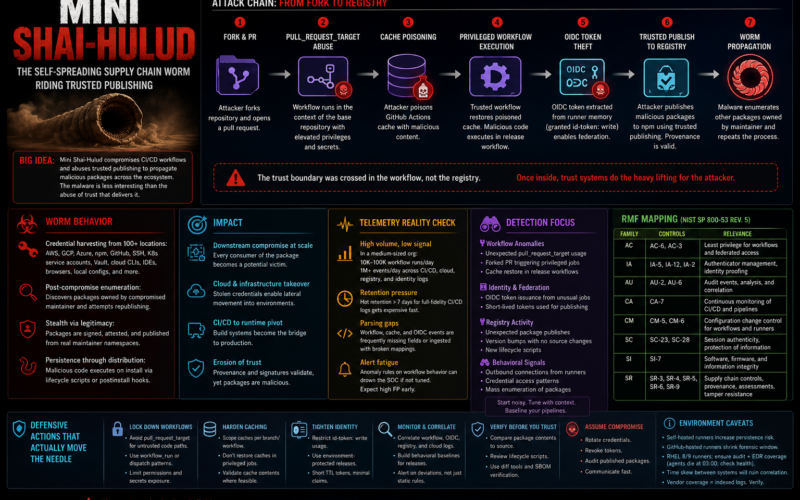
Mini Shai-Hulud and the Collapse of Software Provenance Trust

The uncomfortable part about Mini Shai-Hulud is not the malware itself. Credential stealers are everywhere. Obfuscated JavaScript loaders in npm packages are not exactly new territory either. The problem is that this thing successfully rode through trusted publishing infrastructure and valid provenance paths, which means a lot of the security plumbing people have been congratulating …

·