SonarQube
SonarQube reads your source code. That is the first thing to get straight, because this page sits in a directory next to ACAS, Nessus, and OpenSCAP, and those tools poke at running systems, open ports, package versions, and STIG settings on a host. SonarQube does none of that. It parses the code in your repository, builds a model of it per language, and flags bugs, code smells, and security-relevant patterns before the thing ever ships. It is static application security testing plus code quality. Not a vulnerability scanner pointed at an IP range, not a compliance checker reading a STIG benchmark, and not DAST throwing payloads at a live endpoint. If an ISSO is expecting it to produce something that looks like a Nessus .nessus file or an OpenSCAP ARF, they’re going to be disappointed, and rightly confused.
The vendor is Sonar. That’s the brand now; the legal entity is SonarSource Sàrl (the prior SonarSource SA was dissolved into it in October 2025), a privately held company out of Geneva that’s been at this since 2008. A 2022 round put the valuation around $4.7B, with Advent International, General Catalyst, Permira, and Insight Partners on the cap table, and as of this writing they are still independent. No acquisition, no IPO, despite the usual pre-IPO-share chatter. Worth confirming at your own publish date, because vendor ownership in this space moves (Fortify is on its third corporate parent), but right now Sonar owns Sonar.
The 2024 rename, because half of you know this tool by its old name
In October 2024 Sonar collapsed everything under the SonarQube brand, and the mapping trips people up constantly. The self-hosted product that everyone just called “SonarQube” is now SonarQube Server. The SaaS that was SonarCloud is now SonarQube Cloud. The IDE plugin that was SonarLint is SonarQube for IDE. And the free download formerly known as the Community Edition is now SonarQube Community Build. The website flipped to the new names on October 29, 2024; the in-product strings, scanner output, and a lot of the docs lagged into December and beyond. So if you’ve got a runbook that says “kick off the SonarCloud scan,” that’s the same product, just renamed.
Versioning changed too, and this one matters for your SSP. Sonar dropped semantic versioning for SonarQube Server in favor of calendar versioning, YYYY.N. The current Long-Term Active release is 2026.1 LTA, with 2026.2 shipped in March 2026 as the latest feature release. The first release of each year is the LTA; six releases land per year on a roughly two-month cadence. “LTA” is the term that replaced “LTS.” If your documentation cites SonarQube 9.9 or 10.x as your version, that’s pre-rename semver, and an assessor who knows the product will read it as stale. The prior LTA line was 2025.x.
Editions, and the line that actually matters
Here is the one thing about licensing that changes how you should think about this tool in a federal context: the real SAST engine, cross-procedural taint analysis, is paid-tier only. Community Build does not get it. It does bug and code-smell rules and some pattern matching, which is genuinely useful, but it is not dataflow security analysis. Branch and pull-request analysis are also paid-only.
| Edition (self-hosted Server) | Cost | Taint / dataflow SAST | Branch & PR analysis | Where it fits |
|---|---|---|---|---|
| Community Build | Free | No | No (main branch only) | Quality gate on a single branch; OSS projects; “is this code a mess” checks |
| Developer | Paid | Yes | Yes | The first tier where the security story is real |
| Enterprise | Paid | Yes | Yes, plus portfolio reporting, OWASP Top 10 for LLM | Multi-team programs, governance reporting |
| Data Center | Paid | Yes | Yes, plus HA clustering | High-availability scale inside a boundary |
SonarQube Cloud (the SaaS) runs a separate ladder: a free tier capped by lines of code and users, then Team and Enterprise plans. Language coverage is roughly 30-plus on free, 35-plus on paid. The 2026.1 release added Rust with native Clippy integration, pushed Java to 22-24, Swift to 5.9-6.2, Python to 3.14, and Dart to 3.8.
Where it sits in the flow, and who runs it
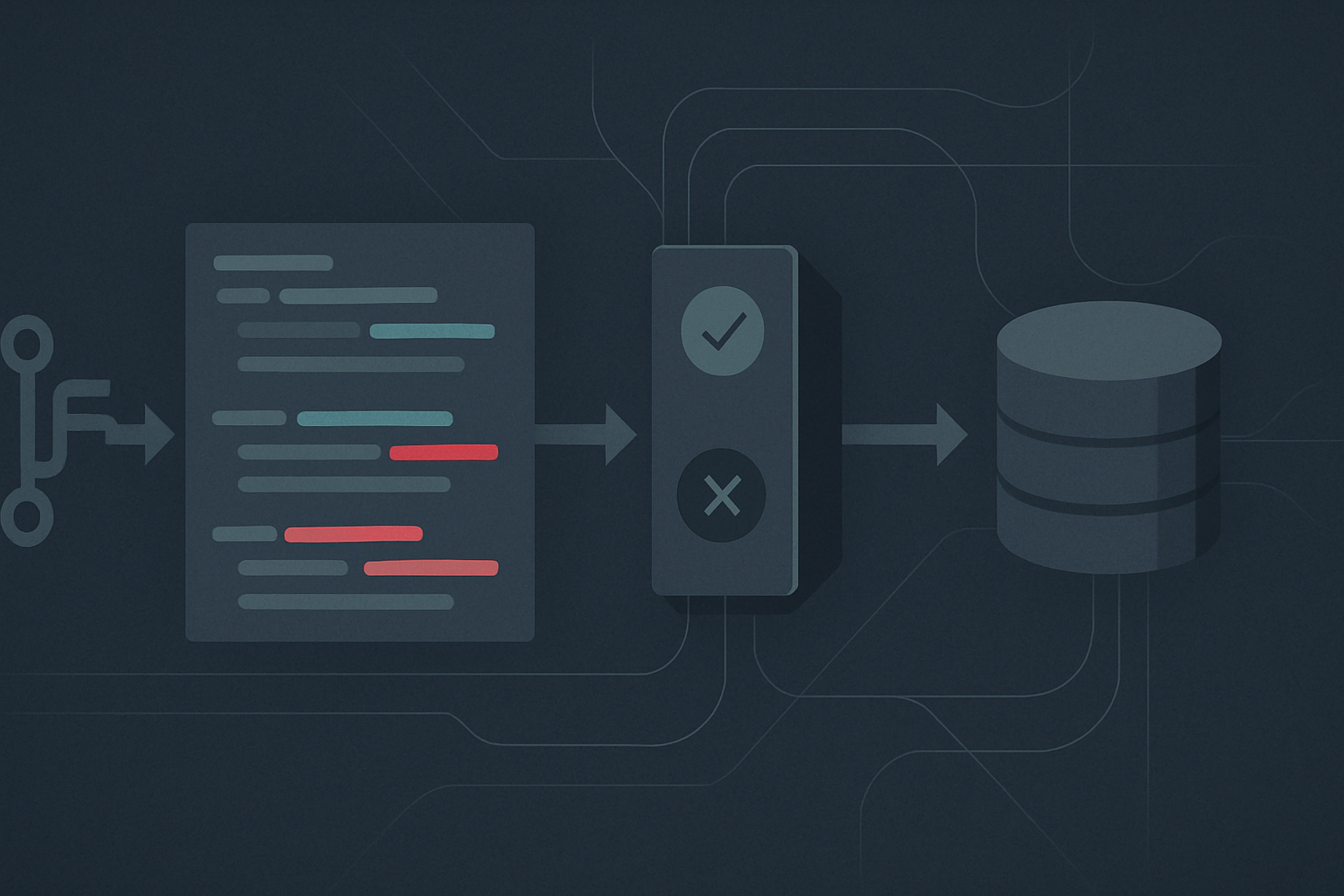
This is a developer and AppSec tool. It lives in the pipeline, not in the assessor’s hands at A&A time. You wire the scanner into Jenkins, GitLab CI, GitHub Actions, or Azure DevOps, and it runs on every pull request and merge. The result is graded by a Quality Gate: a set of pass/fail conditions, and the gate either lets the build through or stops it. The Sonar philosophy here is “Clean as You Code,” which in practice means you configure the gate to fail only on new code. You don’t try to boil the ocean of legacy debt on day one. New code that introduces a blocker bug or a security hotspot fails the gate; the decade of accumulated smells in the old monolith doesn’t block today’s merge. Configure the gate on new-code conditions or the whole model falls apart and teams start ignoring a permanently-red dashboard.
In RMF terms, this produces developer security-testing evidence. It is SA-11 artifact generation, the output a development team hands to an assessor to show they’re doing static analysis in their process. It is not a scan an ISSO runs against a categorized system at assessment time. Keeping that distinction clean in the SSP saves an argument later.
Federal and DoD posture: self-hosted is the answer
No standalone FedRAMP authorization exists for SonarQube Cloud. Don’t write “FedRAMP Authorized” against it, because it isn’t, and that’s the kind of claim that surfaces in a review and costs you credibility on everything else in the document. (The FedRAMP program itself has been shifting its terminology around “authorized” recently, but that doesn’t change the answer here.)
The federal path is self-hosted SonarQube Server inside your boundary. Sonar publishes STIG-hardened SonarQube Server container images to Iron Bank, the Platform One hardened-container registry, so the DoD-approved supply chain for getting this thing into an IL4+ environment already exists. You pull the hardened image, stand up the Server with its Postgres backend (Data Center edition if you need HA), and run analysis against code that never leaves the enclave. That’s the deployment shape that holds up. The SaaS does not.
What it’s good at, and what people gripe about
The good: deep per-language analysis that genuinely understands the code, not regex-on-source. Low-ceremony PR feedback that shows up where developers already work. The Quality Gate gating model is clean and teams actually adopt it. On paid tiers the taint engine traces tainted input across function boundaries, which is the part that earns the “security” label. The IDE feedback loop with Connected Mode, where the IDE pulls the same ruleset and quality profile as the server, closes the gap between “the analyzer flagged it” and “the developer sees it before committing.”
The gripes are real and you should hear them. False positives and rule noise are a recurring complaint; tuning the quality profile is not optional, and the first few weeks of a new project are loud. Quality Gate friction generates its own politics when a gate blocks a release the business wanted yesterday. The rebrand churn left scanner names, CLI references, and docs out of sync for months. And analyzer-version drift between the scanner running in CI and the Server doing the aggregation produces results that don’t reconcile, which is maddening to debug.
Here’s my contestable take, and I’ll mark it as opinion: Community Build is a code-quality tool wearing a security badge, and the security story doesn’t actually begin until Developer Edition. Without taint analysis you have a linter with good UX. A team that stands up the free tier, sees “security hotspots” in the UI, and reports up the chain that they’ve got SAST coverage is fooling themselves and possibly their AO. The dataflow analysis that catches the injection bug crossing three functions is the thing you’re paying for, and the free tier doesn’t have it. People conflate the two constantly, and Sonar’s own marketing doesn’t go out of its way to un-conflate them.
Deeper: why RA-5 is the wrong control to map this to. The reflex in a /scans/ directory is to file everything under RA-5, vulnerability monitoring and scanning. Resist it for SonarQube. RA-5 is about scanning systems and hosts for known vulnerabilities, the Nessus and ACAS job. SonarQube reasons about source code in a repository, which is a different evidence type entirely. The clean ties are SA-11 (developer security testing, and specifically SA-11(1), static code analysis, which is almost a textbook description of SAST in CI) and SA-15 (development process, standards, and tools, including automated analysis). There’s a lighter SR thread if you’re using it for any software-composition angle, but Sonar is primarily a first-party-code analyzer and is weaker on third-party dependency CVEs than something purpose-built like Snyk or Anchore, so don’t overstate the supply-chain coverage. CM-6 isn’t a fit either; SonarQube doesn’t read configuration baselines. Map it to SA-11 and SA-15, note the SR caveat honestly, and explicitly say RA-5 does not apply so nobody downstream miscategorizes it.
The 2026 AI angle
Sonar acquired AutoCodeRover in February 2025, an autonomous AI code-repair agent out of NUS that posted strong SWE-bench numbers. That acquisition is the foundation under Sonar’s current AI-fix and AI-code-assurance push. The relevant feature for assessors is AI Code Assurance: you mark a project as containing AI-generated code, apply an AI-qualified Quality Gate, and the project gets analyzed against standards tuned for the failure modes of LLM-written code. The 2026.1 release also added OWASP Top 10 for LLM reporting, though that one is Enterprise and Data Center only. If your shop is shipping AI-generated code into a federal boundary, this is the part of the tool worth a closer look, with the standing caveat that “tuned for AI code” is a young feature and you should validate what it actually catches before you lean on it in an SSP.
Sources
- SonarQube Server 2026.1 LTA, What’s New (Sonar)
- SonarQube Server release notes (Sonar Documentation)
- Release cycle model, LTA and calendar versioning (Sonar Documentation)
- Sonar streamlines product naming (Sonar press release)
- Brand identity and product name refresh (Sonar)
- Sonar acquires AutoCodeRover (Sonar press release)
- AI Code Assurance (Sonar Documentation)
- Federal Government secure software supply chain (Sonar)
- Iron Bank FAQ (Platform One / DSO)
- SonarSource company profile (PitchBook)
- SP 800-53 Rev. 5, Security and Privacy Controls (NIST)
Adjacent material on this site
- Fortify (the other heavyweight SAST engine in this directory, now under OpenText)
- Checkmarx (SAST competitor with a different gating model)
- Snyk (stronger on the SCA and dependency-CVE side SonarQube is light on)
- Anchore (software-composition and container scanning, the SR-family complement)
- GitHub Advanced Security (SAST and secret scanning native to the repo)
- SA family, System and Services Acquisition (where SA-11 developer testing actually lives)
- RA family, Risk Assessment (RA-5, the control this tool does not satisfy)
- Scanners and scanning tools overview