Trellix Source Code Breach: What’s Confirmed, What Isn’t, and What EDR Customers Should Do
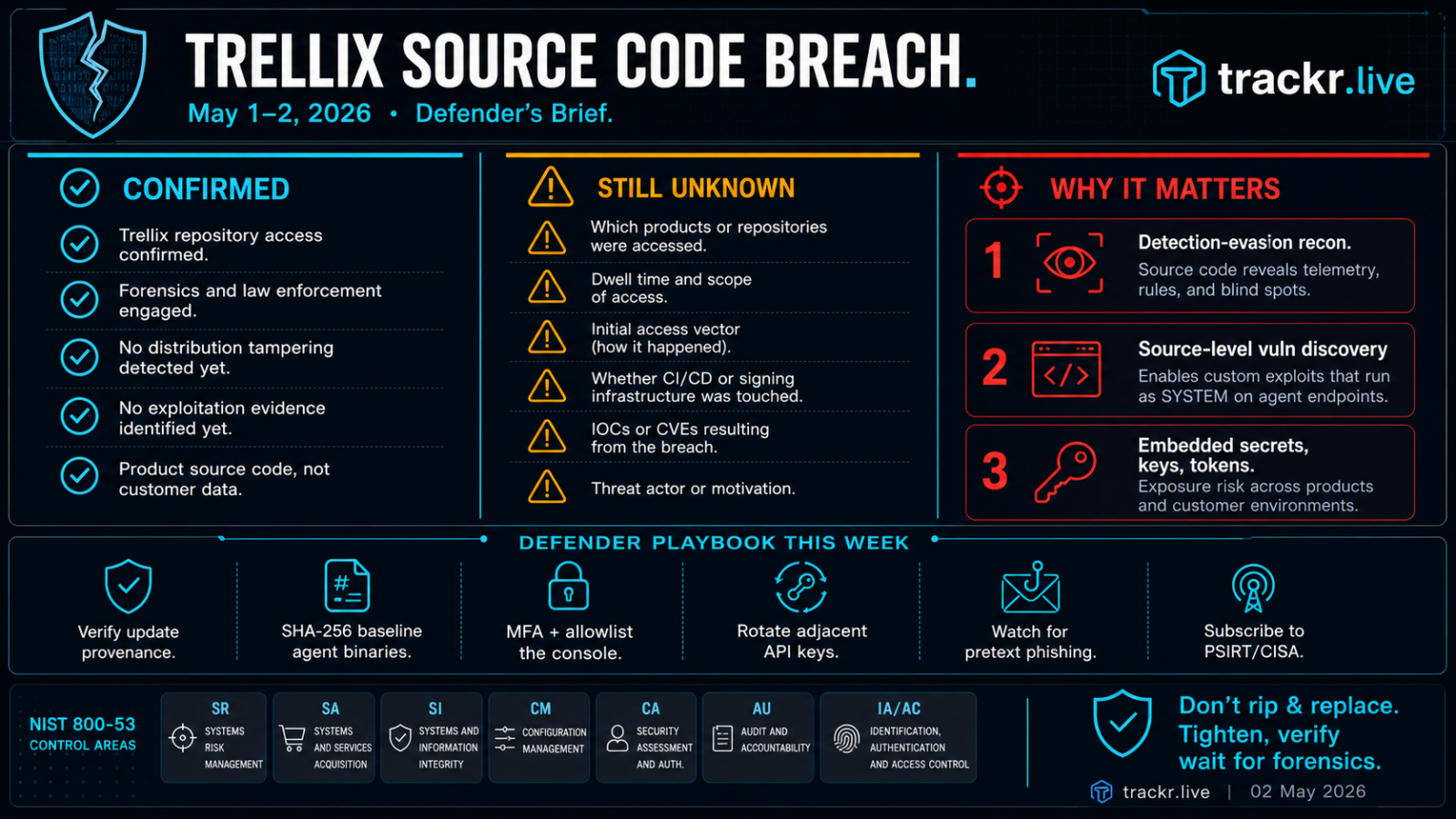
On May 1–2, 2026, Trellix published a short notice on its corporate site (https://www.trellix.com/statement/) confirming that an attacker reached part of its source code repository. The wording is the usual minimum-viable disclosure: forensic experts engaged, law enforcement notified, no evidence so far that the release or distribution pipeline was tampered with, and no evidence the code itself has been exploited. The Hacker News, SecurityAffairs, CybersecurityNews, and Integrity360 all carried the story within twenty-four hours, and none of them had materially more than what Trellix itself said. No threat actor has been named. No timeline of access has been published. No IOCs. No CVE. The company has promised more detail later.
That is roughly the worst shape of disclosure for defenders: enough to know something happened to a security vendor whose agents run as SYSTEM on hundreds of thousands of endpoints, not enough to do anything precise about it. The right response is to assume the vendor’s investigation is incomplete and to act on the threat model rather than waiting for the IR report.
What Trellix has actually confirmed
From the official statement and corroborating coverage at https://thehackernews.com/2026/05/trellix-confirms-source-code-breach.html and https://securityaffairs.com/191584/data-breach/trellix-discloses-the-breach-of-a-code-repository.html:
- Unauthorized access to a portion of an internal source code repository.
- Trellix engaged external forensic experts and notified law enforcement.
- No evidence, as of the statement, that the source code release or distribution process was affected.
- No evidence the source code has been exploited.
- Per Integrity360’s advisory (https://insights.integrity360.com/threat-advisories/security-advisory-unauthorised-access-to-trellix-internal-source-code), the affected material is product development code and does not, on current evidence, include customer environments or customer data.
What is conspicuously missing: which products, which repositories, which branch or tag set, what authentication path the attacker used, dwell time, and whether build artifacts, signing infrastructure, or CI/CD pipelines were touched. “No evidence the distribution process was affected” is a present-tense claim with no scope statement attached to it.
What the threat model actually is
Trellix is the post-merger entity from McAfee Enterprise and FireEye, sitting on EDR, XDR, email security, and a sizable government and DIB customer base. Source code from that portfolio has three flavors of value to an adversary, in increasing order of severity:
- Detection-evasion intelligence. Reading agent code reveals which behaviors are sensor-visible, which API hooks are monitored, what is queued vs. inline-blocked, and where the engine has blind spots. This is reconnaissance that doesn’t require an exploit.
- Vulnerability discovery. Auditing C/C++ kernel and user-mode components for memory safety bugs is dramatically faster against source than against compiled binaries. Privileged endpoint agents are an attractive target precisely because a bug in the agent runs at SYSTEM.
- Embedded secrets. Repositories routinely contain API keys, signing references, internal endpoints, telemetry tokens, and partner integration credentials. The 2022 LastPass and the more recent Okta source-code incidents both surfaced material that mattered well beyond “someone has the code.”
None of these require the release pipeline to have been touched. The damage from a read-only theft of EDR source code is an asymmetric advantage to whoever has it.
Mapping the exposure to NIST 800-53
For an ISSO or ISSE writing this up in an SSP impact analysis, the relevant families are not exotic.
| Family | Relevance to this incident |
|---|---|
| SR | Supply-chain risk from a security tooling vendor; SR-3, SR-6, SR-11 all apply to ongoing monitoring of vendor incidents. |
| SA | SA-9 external system services and SA-15 development process — the vendor’s own SDLC integrity is now a control you are inheriting. |
| SI | SI-7 software, firmware, and information integrity — the case for verifying signatures and hashes on every Trellix update just got concrete. |
| CM | CM-3 and CM-7 — change control and least-functionality posture for the agent itself; CM-8 inventory of what’s actually deployed. |
| CA | CA-7 continuous monitoring — bump the cadence of vendor-incident review and POA&M entries while the investigation is open. |
| AU | AU-6 review and analysis — turn up the volume on Trellix agent telemetry and on host-side observation of the agent. |
| IA / AC | IA-5 and AC-2 / AC-6 for the repository compromise pattern itself; assume the initial vector was credential or token theft until proven otherwise. |
If your ATO package treats vendor-side compromise as an inherited risk that the vendor handles, that assumption needs revisiting in this calendar quarter.
What defenders should do this week
With no IOCs published, the work is preventive and integrity-focused.
- Verify update provenance. Pin Trellix update sources to known endpoints, enforce TLS validation, and confirm Authenticode / code-signing chains on every binary the agent drops. SI-7 territory.
- Hash and baseline deployed binaries. Capture a current SHA-256 baseline of agent binaries, drivers, and configuration files across the fleet. Alert on drift outside of advertised update windows. This is the single most useful thing to have if a tampered build does surface later.
- Constrain the agent’s blast radius where possible. Network egress for the management plane should go to a known allowlist. EDR consoles should be MFA-enforced and behind conditional access; treat the console as a tier-0 admin surface.
- Hunt for credential and token exposure adjacent to Trellix integrations. API keys for SOAR, SIEM, ticketing, and identity provider integrations that live in or near Trellix tenants should be rotated on the same cycle you’d use after any vendor incident of unknown scope.
- Watch for second-order phishing. Source-code disclosure incidents are reliably followed by social engineering against the affected vendor’s customers, citing the breach as a pretext for “urgent” patches or support tickets.
- Track the disclosure. Subscribe to Trellix’s statement page, the vendor PSIRT feed, and CISA advisories. When IOCs or specifics land, you want them in your detection pipeline the same day.
Do not rip Trellix out of the environment on the strength of this disclosure. Replacing an EDR under pressure introduces more risk than the current threat model justifies. Tighten controls, verify integrity, document the decision, and wait for the forensic detail Trellix has promised.
Source-code theft from a security vendor is a slow-burn problem. The exploit window opens months later, when someone publishes a CVE in an agent that suddenly has a working PoC out of the gate. The work to do now is the unglamorous kind: integrity baselines, signature verification, and a supply-chain risk entry that doesn’t get closed until Trellix actually finishes its investigation.